Machine Stable specializes in complete excavators, loaders and their attachments.













Rotary Drilling Techniques for Karstic Foundation Piles
Introduction
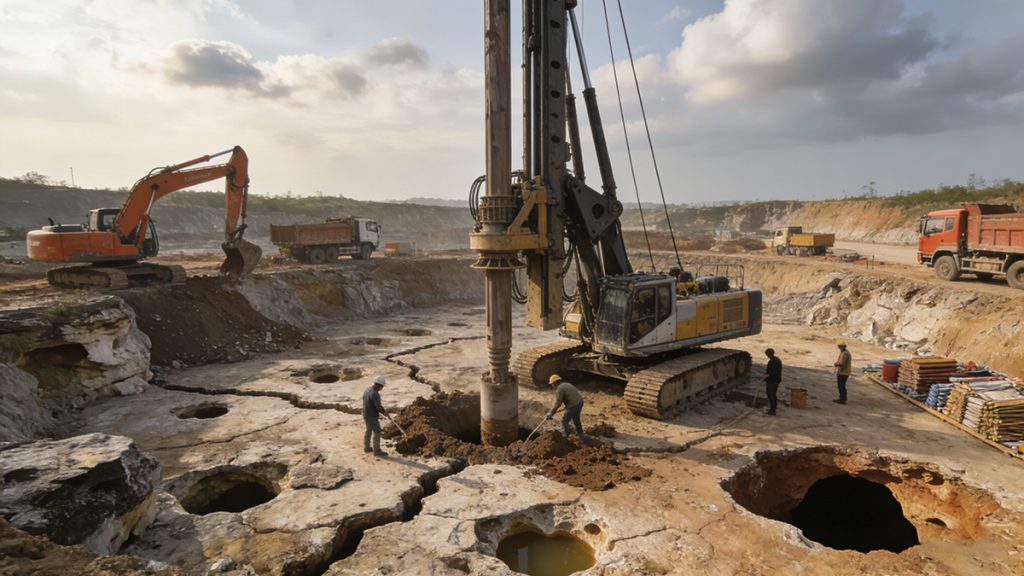
Constructing bored piles in highly karstic limestone formations is one of the most challenging tasks in geotechnical engineering. At the Montclair River Bridge in Pennsylvania, we encountered extensive sinkholes, solution channels, and irregular cavities, with jagged roofs and uneven floors.
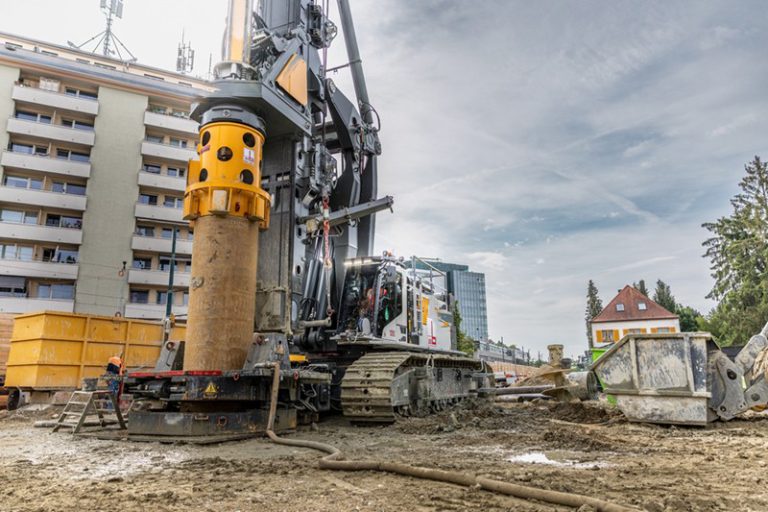
Using a rotary drill rig in such formations required a combination of field intuition, real-time adjustments, and precise equipment control.
“No matter how advanced the rig, understanding the formation and anticipating cavity behavior is what ensures success,” said our senior site engineer.
Project Overview
- Bridge Length: 12 km
- Pile Diameters: 1.0–1.5 m
- Maximum Pile Depth: 85 m
- Total Piles Installed: 3,200+
Key geological challenges:
| Pier | Cavities | Height | Notes |
|---|---|---|---|
| 203 | 13 interconnected | 2–8 m | Multiple semi-filled voids |
| 286 | 1 large | 25 m | Critical for pile stability |
Highly variable cavities required precise sequencing and rig adaptation.
Geological Challenges
The main challenges we faced were:
- Interconnected cavities forming complex networks.
- Partially filled voids with sand or clay prone to flow.
- Groundwater infiltration, causing slurry loss.
We combined geophysical surveys with exploratory boreholes to guide the deployment of rotary pile drilling rigs and determine drilling sequences for each pier.
Equipment Selection and Field Notes
Selecting the right drilling rig was crucial. Our choices and field observations:
| Rig Type | Application | Field Notes |
|---|---|---|
| Hydraulic Rotary Drilling Rig | Hard limestone | High torque, adjustable stroke prevents borehole deviation |
| Mud Rotary Drill Rig | Semi-filled cavities | Maintains slurry wall; prevents collapse |
| Dual Rotary Drill Rig | Alternating soft and hard layers | Flexible rotation/feed rate; 3–5 m/day in deep piles |
| Rotary Foundation Drill Rig | Standard piles | Reliable and versatile for general piles |
| Rotary Core Drilling Rig | Large cavities | Supports cavity filling with clay, crushed stone, straw |
Adjustments to the drill rig rotary head and rotary table in drilling rig were made constantly based on lithology and cavity feedback.
Drilling Sequence
To ensure safety and efficiency:
- Deep piles first – anchors the structure.
- Edge/corner piles – isolate cavities.
- Central piles – drilled last to avoid interference.
At Pier 203, this sequencing minimized risk when central piles encountered interconnected cavities.
Borehole Stabilization Techniques
Maintaining borehole integrity relied on mud support and artificial walls:
- Mud Support: high-viscosity clay-bentonite slurry; sometimes reinforced with cement to block flow in semi-filled cavities.
- Artificial Walls: clay blocks, crushed stone, straw, placed and compacted using a rotary core drilling rig.
| Technique | Purpose | Implementation Notes |
|---|---|---|
| Mud Support | Prevent wall collapse | Adjust viscosity and cement ratio based on cavity size |
| Artificial Wall | Strengthen cavity | Clay blocks + crushed stone + straw; compacted with rotary core drilling rig |
| Underwater Concrete Sealing | Seal interconnected voids | Concrete poured 2–3 m above cavity roof; wait 0.5–1 h before drilling continuation |
Small changes in feed rate or torque could make or break borehole integrity.
Managing Interconnected Cavities
- Backfilling: clay-stone mixture reinforced with cement.
- Underwater concrete sealing: ensures void closure.
- Sequential drilling: avoid overlapping slurry loss zones.
This method proved effective at Piers 289–290, preventing frequent slurry loss and allowing completion with rotary pile drilling rigs.
Operational Considerations
Key practices on-site:
- Monitor the rotary head – torque and stroke adjustments based on lithology.
- Control the rotary table in drilling rig – regulate feed rate and rotation speed.
- Stagger multiple rigs – prevents interference in high-risk zones.
Continuous monitoring prevented borehole deviation and ensured wall stability.
Dual Rotary Drill Rig Performance
The dual rotary drill rig was particularly effective in alternating soft and hard layers:
- Balanced penetration speed and stability.
- Maintained borehole integrity in cavity-rich areas.
- Enabled daily progress of 3–5 meters in deep piles.
Flexibility and precision made dual rotary rigs indispensable in complex karstic formations.
Field Lessons
- Map cavities thoroughly before drilling.
- Sequence drilling strategically to manage risk.
- Use mud support and artificial walls.
- Monitor torque, feed rate, and slurry properties continuously.
- Deploy multiple rigs strategically: rotary foundation drill rig, hydraulic rotary drilling rig, mud rotary drill rig, dual rotary drill rig, rotary core drilling rig.
Conclusion
Bored pile construction in highly karstic formations using rotary drill rigs demands preparation, real-time observation, and adaptive operations. Correct rig selection and careful control of the drill rig rotary head and rotary table in drilling rig ensured safe, efficient, and reliable pile installation.
Field experience, adaptive techniques, and real-time problem solving are key to success in challenging karstic terrains.