Machine Stable is an authorized distributor of the DEVELON brand under HD Hyundai.


Why Forged Bucket Teeth Are Expensive
This is one of the questions I hear most often after years of participating directly in equipment selection, spare‑parts procurement, and on‑site construction management across overseas projects.
In large‑scale projects across North America’s quarries, Australia’s mining sites, and Middle Eastern earthmoving operations, I have worked closely with excavator and wheel loader users under a wide range of operating conditions. Regardless of machine brand or project scale, bucket teeth remain one of the most frequently replaced yet most underestimated wear components. That is exactly why many contractors are initially shocked when they see the price of forged bucket teeth.
This article focuses on one core question: why forged bucket teeth are expensive—and why that cost is technically justified in high‑intensity construction environments.
The Real Role of Bucket Teeth in Construction Systems
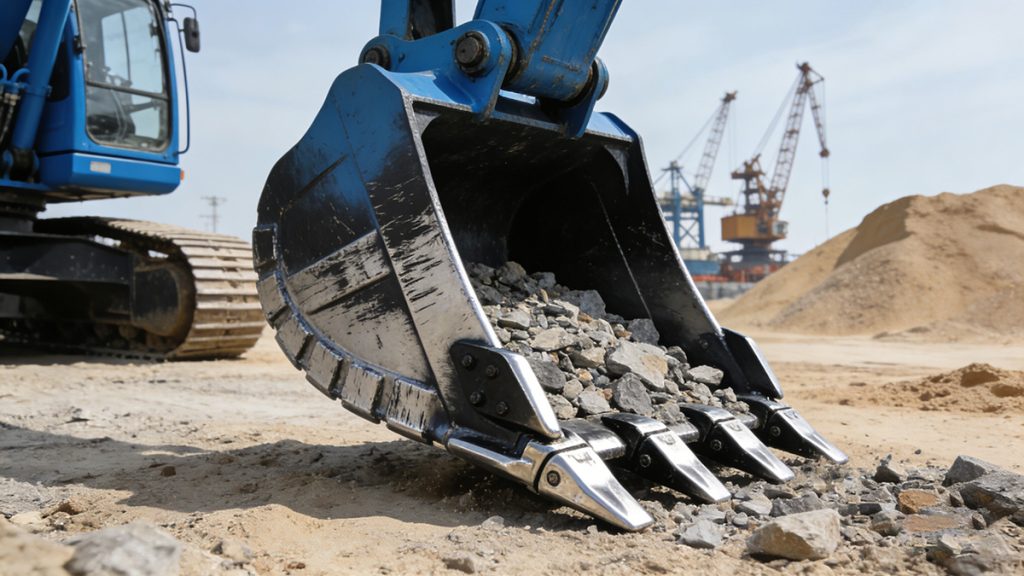
From an engineering perspective, bucket teeth are not simple consumables. In a Canadian open‑pit quarry project I managed, bucket teeth directly determined whether the excavator could penetrate the working face efficiently. They act as the primary load‑bearing interface where nearly all excavation resistance is concentrated.
Bucket teeth endure not only abrasive wear, but also impact loads, shear forces, and cyclic fatigue stress.
In hard‑rock excavation scenarios, tiger teeth for excavator bucket configurations are often selected because their geometry and load‑transfer paths significantly affect engine load, hydraulic pressure stability, and fuel efficiency.
From a system‑engineering standpoint, bucket teeth serve several critical functions:
- Protecting the bucket body and delaying structural wear at the lip and tooth adapter
- Reducing cutting resistance and increasing effective production per operating hour
- Absorbing impact energy to reduce fatigue damage to the boom, arm, and linkage
These functions alone make it clear that bucket teeth should never be selected based solely on initial purchase price.
Structural Design and Installation Methods Affect Cost
In real‑world construction, the two most common installation structures are vertical pin (direct‑fit) and horizontal pin systems. Each design follows a different mechanical logic and places very different demands on material performance and manufacturing precision.
Structural design determines whether bucket teeth can remain secure under high‑impact loads—this is where forging begins to show its value.
Characteristics of Vertical Pin Systems
- Pins carry load vertically
- Faster removal and installation
- Common on compact equipment
- Well suited for bucket teeth for mini excavator applications
Characteristics of Horizontal Pin Systems
- Pins carry load laterally
- Higher resistance to impact forces
- Greater dependence on internal material strength
- Common on excavators above 20 tons
During changing teeth on excavator bucket operations, horizontal systems often require dedicated tools and controlled force application to avoid damage to adapters and locking mechanisms.
Operating Conditions Define the Performance Threshold
During an iron‑ore project in Western Australia, I compared bucket tooth wear patterns under different ground conditions on the same machine. The results were consistent:
- Soft soil: wear dominated by surface abrasion
- Rock strata: failures driven by chipping, cracking, and root fracture
This is why rock teeth for excavator bucket designs are standard in abrasive and high‑impact environments.
When reviewing excavator bucket teeth for sale on the market, forged and cast options clearly occupy different price tiers. This separation is not marketing inflation—it reflects fundamentally different manufacturing principles.
Casting vs. Forging: Fundamental Manufacturing Differences
What Defines Cast Bucket Teeth
Cast bucket teeth are produced by pouring molten metal into molds. Their advantages include:
- Lower tooling cost
- Reduced unit manufacturing expense
- Suitable for light‑duty, short‑cycle operations
However, in multiple failure investigations I have participated in, cast teeth frequently exhibited:
- Internal porosity
- Inconsistent grain structure
- Brittle fracture under impact loads
As a result, excavator bucket teeth replacement intervals were significantly shorter in demanding applications.
What Defines Forged Bucket Teeth
Forged bucket teeth are formed by applying high pressure to heated steel billets, forcing the grain structure to flow along load paths. The results include:
- Dense internal structure
- Superior impact resistance
- Significantly extended fatigue life
Across three independent projects, forged bucket teeth consistently achieved 1.8–2.2 times the service life of cast alternatives under identical operating conditions.
Material Cost Is Only Part of the Price Difference
Many buyers assume forged bucket teeth are expensive simply because they use “better steel.” In reality, excavator bucket teeth material accounts for only part of the cost.
Key cost drivers include:
- Multi‑stage heat treatment processes
- High‑tonnage forging press investment
- Tooling wear and die maintenance
- Tight dimensional tolerance control
Additionally, when precision matching with excavator bucket teeth adapters is required, forged components provide more consistent long‑term fit and load distribution.
Productivity and Lifecycle Cost Comparison
The following table summarizes the evaluation method I commonly use during project reviews:
| Evaluation Factor | Forged Bucket Teeth | Cast Bucket Teeth |
|---|---|---|
| Initial Purchase Cost | Higher | Lower |
| Service Life | Longer | Shorter |
| Replacement Frequency | Lower | Higher |
| Unplanned Downtime | Minimal | Frequent |
| Total Lifecycle Cost | Lower | Higher |
In high‑utilization operations, crews often rely on a dedicated excavator bucket teeth removal tool. Forged teeth are less prone to deformation during removal, reducing collateral damage to adapters and pins.
Why Professional Contractors Prefer Forged Bucket Teeth
Across the projects I have managed, experienced contractors follow a consistent principle:
When operating conditions are unpredictable, prioritize the most reliable component available.
Although forged bucket teeth carry a higher upfront cost, they significantly reduce:
- Unplanned stoppages
- Secondary damage to adapters and bucket lips
- Emergency on‑site repairs
These indirect savings frequently exceed the initial price difference between forged and cast teeth.
Conclusion: Forged Bucket Teeth Are Expensive—For Clear Engineering Reasons
Returning to the original question—why are forged bucket teeth expensive?
From an engineering standpoint, the reasons are clear:
- Complex manufacturing processes
- Superior internal material structure
- Longer service life under high stress
- Lower total cost over the equipment lifecycle
If your operating environment involves high impact loads, abrasive materials, and unpredictable conditions, forged bucket teeth are not simply “expensive”—they are the more rational engineering choice.